Pages

Saturday, June 15, 2013

Mexico’s Community Forestry Helps in Rainforest Conservation


It is real important for us people to realize the great importance of natural rainforests to us. From the air we breathe, the home that shelters us, up to the foods that sustain us, a big portion of our lives is dependent on the existence and sustainability of this natural resource. This time is never the moment for closing our ears from hearing and our eyes from seeing, this is the time for unique awareness and most importantly, action. 

Mexico’s Response to the Worldwide Call

The issue of gradual deforestation is not just a problem of a few countries in the world, but rather a global concern. In Mexico, Forestry Communities are on the frontlines when it comes to rainforest conservation. These organizations help the communities in managing their rainforests well for protecting not just the environment as well as the livelihood of the people. 

This action is a significant response from Mexico especially that their country is a home to unique species of plants and animals that cannot be found on no other place in the Earth. In fact, Mexico is among the 12 most ‘mega diverse ’nations in the world and is known for its extreme richness of flora and fauna. A wide variety of tree species is found in Mexico’s rainforests reaching the number of 1,000 native species knowing that almost thirty percent of their total land area is covered by rainforests. 

However, no matter how we get amazed of Mexico’s natural richness, the nation is on for a serious threat. Despite it being one of the richest and most diverse, Mexico also has one of the highest rates of deforestation in the world. They are losing 330,000 hectares of their forests every year.
The last twenty-five years is a breakthrough for Mexico. Coming from the fact that 80% of their rainforests are under the jurisdiction of communities, the Forestry Communities saw it as a possible asset for recovering and preserving the remaining rainforests. Community Forest Enterprises (CFEs) have been established to practice sustainable forest practices in every community. 

However, many of Mexico’s communities are not in the move to practicing sustainable management for increasing the potential of rainforests not just for preservation but also for livelihood purposes. Only a minimal portion of communities involved can be said to have reached a significant level of business development. On a brighter note, there are other forest conservation programs that assist CFEs in becoming more competitive in local and even in international markets. 

Image credit: http://www.arborday.org/

Saturday, June 8, 2013

Uncover the Beauty of Lacandon Jungle in Mexico


Among all other countries in the world, Mexico is considered to be one of the most beautiful. In here you can not consider yourself lonely and alone, for the natural wonders and biodiversity will always make you feel welcome. Not only that, the hospitality and friendliness of the Mexican people along with nature will always make you feel at home.

Without a doubt, the Lacandon Jungle in Mexico is one of its top valuable places. Lacandon is located in the state of Chiapas near the Lacanja Village. The place is inhabited by the remaining Mayan people, one of the important people in Mexico’s history. The Mayans are also called by the name of Lacandons- where the place got its name. Literally, “Lacandon” means ‘those who set up stone idols’ justified by the stone head statues at La Venta. The Mayans are known in history for their knowledge in Mathematics and time and their devised 365-day calendar. At present we’ve been hearing about the ‘end of the world’, but in reality, the dates presented were just the end of the Mayan calendar.


Natural Resources of Lacandon

The area is surrounded by great rivers, lakes, lagoons, and waterfalls making it a very suitable place for wildlife and their survival. Several crops grow in the area and a wide variety of animals are present. Before, the bodies of water in Lacandon are completely preserved, but as time goes by, due to human activities and industrialization, about 40 to 70% are destroyed. 

There are still 1500 tree species in Lacandon most common of which are mahogany, sapodilla, and breadfruit tree. About 3000 species of vascular plants still exist. 

Archeological Zones in Lacandon

Before approaching the Lacandon jungle, there are several historical sites that well introduce the beauty of the area. First is the archeological site of Yaxchilan famous for its wide vegetation area and amazing sculptures that dates back to Mayan Classical Period. Among the sculptures are the Grand Acropolis, Small Acropolis and the Grand Plaza. Another is the Bonampak site which contains the Mural Temple considered to be the most [reserved work of the Mayans. The temple is known for its murals on one of its buildings painted by the Mayan people.  Meanwhile, Las Nubes is known for its rich ecotourism. It is found along Santo Domingo River popularized by its turquoise waters. The people in the area are working hand in hand to preserve the natural wonders of Las Nubes.

Image credits: http://climate-connections.org/

Sunday, May 12, 2013

About the Rainforests of Mexico


The rainforests of Mexico are considered to be one of the most tropical at present. As the name implies, rainforests receive great amount of rainfall each year, that’s why Mexico holds a considerable variation of species of plants and animals. Besides that, the location of the rainforests between the North and South America is important to the migration of other species of animals. 


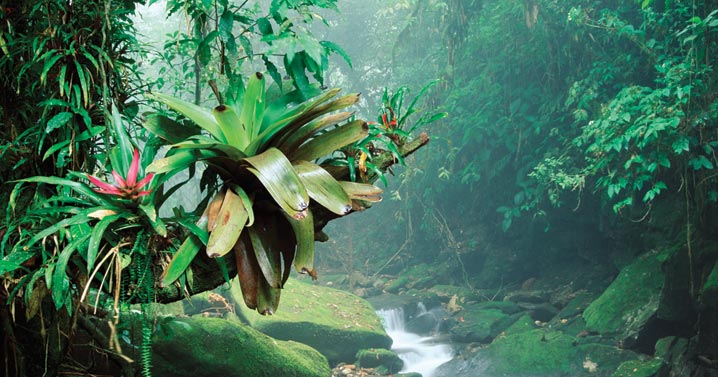
From the City of Mexico to the Gulf of Mexico in the lower elevations are covered by rainforests—tropical and subtropical. Most rain is received by those near the coasts. The amount of rain accounts for the stability of the climate making it essential for the growth and maintenance of the species. In fact, trees are normally reaching the height of 30 meters with dominant species like Mahogany and the Sapodilla. In areas with higher latitudes, rainforests are amazingly covered with fog supporting the growth of aerial plants called epiphytes, ferns and mosses.

It is claimed that tropical rainforests hold about 50 to 90 percent of all species on Earth. In Mexico, the rainforests houses 2,000 species of plants. No wonder the Amazon rainforest provides a fifth of the world’s oxygen.  Of course, Mexico rainforests will never be least in providing home to several animal species. It includes 40 reptiles, 15 species of amphibians, 90 mammal species, and over 200 varieties of birds. As we look to it, you will never get bored of animal and plant watching because your eyes will definitely be amazed of its rich biodiversity.

Unfortunately, Mexico rainforests also house different endangered species of animals. It includes species of big cats like the jaguar, jaguarundi, and the ocelot. Not just that, there are also Spider Monkey, Coati, and Kinkajou species of animals that are considered threatened.

Dangers of the Rainforests of Mexico

As all remaining rainforests in the world, Mexico cannot escape threats to its survival. According to studies and monitoring, over 500,000 hectares of Mexico’s tropical and subtropical rainforests are destroyed each year. Several threats account to its destruction like industrialization, agricultural expansion, logging, and the collection of raw materials by the locals. Because of destruction of habitat, about 285 species of vertebrates are in the alarming condition.

Photo credits: http://www.edf.org

Saturday, May 4, 2013

White tailed Deer (Odocoileus virginianus)


The White-tailed deer is commonly known at the continent of America but is also introduced to some countries in Europe. This is a medium-sized deer also known to be the Virginia deer. Deriving from its name, this deer is easily distinguished by its white underside seen when the deer raises its tail as a sign of escape.

Photo credits to: http://resources.waza.org/
Physical Description and Characteristics

The white-tailed deer changes its color during two different seasons: it is tanned or brown during the summer and grayish-brown in the winter. The male species known as stag or buck have antlers and can weigh up to 130 kilograms. Also, the white tailed-deer have dichromatic vision compared to trichromatic vision in humans. They cannot easily distinguish red and orange colors. There are rare cases when females have antlers; usually associated with the condition called hermaphroditism. All white-tailed deer have white coloration on their nose, around their eyes and in the neck.

Habitat

White-tailed deer are considered to be generalists and are able to adapt to a wide variety of habitats. They mostly occur in wooded areas, but can also be found living in savanna and sage communities in Mexico. Living in savanna areas caused some body adaptations to deer like having large antlers. Deer and humans can both share the same habitat, but there have to be someone dominating.

Behavior and Feeding

White-tailed deer have the behavior of raising its tail showing its white underside when threatened. They can also do some warning signals to other deer like stamping of hooves and snorting. White-tailed deer are active at night, but they are not completely nocturnal. They do not sleep for long periods of time and do not bed on the same position even twice of their life. Whitetails communicate by using vocalizations and by means of their scents.

White-tailed deer are herbivores and their diet primarily depends on their habitat and the time of the year. For example, when summer their primary diet consists of green plants while they eat nuts and corns in the fall. They have a special kind of stomach making them able to eat foods that humans cannot. They are ruminant—having four chambers in their stomach that makes them eat a variety of food.

Antlers

One defining feature of Whitetails is their antlers. It is proven that this asset is a sign of dominance for a male deer. The more branched antler they have, the more attractive they are for does. Antlers are composed of bone and regrow every spring time. 

Saturday, April 20, 2013

Take a Peak on Mexican Culture

The culture of Mexico of the present time can be traced back to the time when indigenous people inhabited areas of the country and the colonization of different nations. It has been said that history in Mexico is not just a trace of the past, but it continues up to the present. Mexico is indeed a place where past meets the present.

Here is a list of aspects of life that defines a true-blood Mexican.

Photo credits to: feelinspired.co.za
Roman Catholicism is the dominant religious orientation in Mexico. Mexicans have established their own religious affiliations even before the colonization of Spain, but since then, the country embraced Catholicism as their spiritual orientation. In fact, the Catholic Church has been one of the most powerful institutions in the life of Mexicans. On the other hand, Mexican Catholicism is considered to be syncretic. There is a mixture of traditional Catholicism and indigenous rituals, considered to be polytheistic by foreign visitors. The Mexicans hold a strong worship of the saints and the Virgin Mary. The Virgin of Guadalupe, the nation’s saint is considered to be a national emblem and as important as the Mexican Flag.

Mexicans have a sophisticated culinary culture.
Cuisine is a mixture of pre-Hispanic and European influences. Corn is the staple food, and is considered sacred by the indigenous people as the Maya and the Aztecs. This food is also prepared by all means, in all possible forms.

In Mexican cooking, three ingredients stand out: hot peppers or spicy chiles, corn and beans. The most important meal for the day is served between two to four in the afternoon locally known as the comida, commonly composed of three to four courses. There are also custom foods for every ceremonial occasion in Mexico. For example, during November 2 when they celebrate the day of the dead, they consume pan de muerto or the bread of the dead. At Christmas, the common delicacies served are romeritos, bacalao, and stuffed turkey.

The Mexican etiquette.
The way how Mexicans deal with each other in daily life is strongly informed by the culture of distance and hierarchies in the society. Generally, Mexicans shake hands or kiss on the cheek when they meet. As in the case of close contacts and special occasions, they embrace each other, tap on the back and shake hands. This culture symbolizes confidentiality and the value of trust.

Mexicans have a strong valuing on eloquence.
They typically began with polite and indirect approaches in conversations before coming up to the main topic. They are indirect speakers and avoid the use of clear-cut statements.

Saturday, April 13, 2013

Mexican Agouti of the Rainforest (Dasyprocta Mexicana)


Ever heard of this animal? Probably not.  Well then, let me introduce you to this strange mammal. Mexican Agouti commonly known as Mexican Black Agouti belongs to the order Rodentia which makes it related to rabbits and rats. It was first introduced to Cuba in the 1930s but can also be seen in the southern part of Mexico. They look quite similar to guinea pigs, but have longer and larger legs. 

Behavioral Characteristics and Description

Agoutis of Mexico are generally blackish-brown in color. They have rounded backs and thin, long legs. The ventral part from the throat to the stomach is whitish-brown in color. Coarse hairs surround their body and raises when threatened. They can grow up to 24 inches in length and can weigh up to 4 kilograms. In their natural habitat, they seem to be shy and flee away from humans and are known for running very fast. 

Agoutis are good swimmers. At night, they hide themselves in tree trunks and among roots. Mexican Agoutis make alarm calls by feet stamping and loud nasal barks while running.

Feeding

Agoutis are primarily fruigivores. When eating, they sit on their hind legs while holding food with their front legs. They eat fallen fruits and leaves but can sometimes climb trees to eat green fruits. They gather up to group of 100 when feeding. Agoutis are also food hoarders; collecting them in small and buried places. Sometimes, they are considered pests to banana and sugarcane plantations. On the contrary, they serve as food sources for cats, birds and snakes.

Take note: Aside from macaws, they are the only animal species that can open Brazil nuts without the use of tools.      

Significance in the Ecosystem

Mexican Agoutis serve as primary seed dispersers. By eating seedlings and dispersing them, they are the ones responsible for wide distribution of tree species to the forest to which they live. They are also food source to other larger species of animals in the forest. Furthermore, several parasitic species depends on Agoutis for survival, like fleas.

Friday, April 5, 2013

How Does Climate Change Affect the Rainforest


As we all know rainforests are the primary absorbers of large amounts of carbon dioxide produced by humans and man-made facilities. To inform you, carbon dioxide levels are now 40% higher than what s experience a century ago. They can benefit, really, but as a saying goes “anything put into excess is bad.” 

So, what’s the biggest worry?

This has to be drought. Apparently, scientific studies in the Amazon rainforest found that tropical rainforest are sensitive to drought. Some of the areas that were once carbon sinks turned out to be carbon sources. How did it happen? Plots subjected to relative decrease in rainfall caused trees to die which resulted to carbon emissions. In a study, it has been reported that intense dry season and lesser amount of rainfall in Amazon in 2005 have caused a 1.2 to 1.6 billion tons of carbon dioxide release. 

In one way or another, rainforests and climate change are interdependent to one another. When climate changes and produce an abnormal amount of rainfall in a rainforest, the trees will eventually die and fail to fulfill their tasks as carbon sinks. In this way, carbon gases will be abundant in the atmosphere, and rainforests will not be solid buffers against climate change.

At present, up to what level are our carbon sinks?

Scientists said that mature tropical rainforests covering about 10 percent of the Earth’s land, absorbs as much as 1.3 billion tons of carbon each year. Thus, tropical rainforests account for forty percent of the world’s carbon sink. On a brighter note, it’s good to know that mature tropical rainforests keep getting better each year in absorbing carbon from the atmosphere.

“Forests have given us subsidy for a long time, and we should never take this for granted”, as an ecologist said. As trusted creations for environment conservation, we should take good care to what is entrusted to us. Let us remember that whatever we do to the environment at present will produce either satisfying or worsening effects extending up to the future generations.


Blogger news

Blogroll