Pages

Showing posts with label rainforest facts. Show all posts

Sunday, May 12, 2013

About the Rainforests of Mexico


The rainforests of Mexico are considered to be one of the most tropical at present. As the name implies, rainforests receive great amount of rainfall each year, that’s why Mexico holds a considerable variation of species of plants and animals. Besides that, the location of the rainforests between the North and South America is important to the migration of other species of animals. 
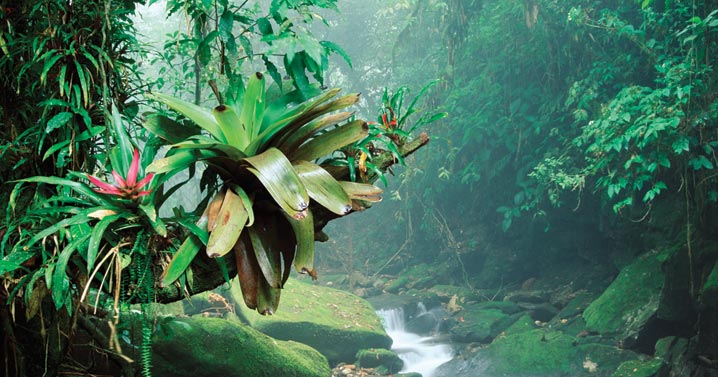

From the City of Mexico to the Gulf of Mexico in the lower elevations are covered by rainforests—tropical and subtropical. Most rain is received by those near the coasts. The amount of rain accounts for the stability of the climate making it essential for the growth and maintenance of the species. In fact, trees are normally reaching the height of 30 meters with dominant species like Mahogany and the Sapodilla. In areas with higher latitudes, rainforests are amazingly covered with fog supporting the growth of aerial plants called epiphytes, ferns and mosses.

It is claimed that tropical rainforests hold about 50 to 90 percent of all species on Earth. In Mexico, the rainforests houses 2,000 species of plants. No wonder the Amazon rainforest provides a fifth of the world’s oxygen.  Of course, Mexico rainforests will never be least in providing home to several animal species. It includes 40 reptiles, 15 species of amphibians, 90 mammal species, and over 200 varieties of birds. As we look to it, you will never get bored of animal and plant watching because your eyes will definitely be amazed of its rich biodiversity.

Unfortunately, Mexico rainforests also house different endangered species of animals. It includes species of big cats like the jaguar, jaguarundi, and the ocelot. Not just that, there are also Spider Monkey, Coati, and Kinkajou species of animals that are considered threatened.

Dangers of the Rainforests of Mexico

As all remaining rainforests in the world, Mexico cannot escape threats to its survival. According to studies and monitoring, over 500,000 hectares of Mexico’s tropical and subtropical rainforests are destroyed each year. Several threats account to its destruction like industrialization, agricultural expansion, logging, and the collection of raw materials by the locals. Because of destruction of habitat, about 285 species of vertebrates are in the alarming condition.

Photo credits: http://www.edf.org

Friday, February 8, 2013

Facts about Your Rainforest


Coined as the Earth’s lungs but in reverse, rainforest “inhales” a large quantity of the earth’s carbon dioxide. Carbon dioxide is a poisonous gas emitted by mammals.  We can attribute the clean air we breathe now with the rainforests.  As a matter of fact, tropical rainforests are the biggest terrestrial source of the air that we breathe.

Only 2 percent of the Earth is composed of rainforest yet it houses almost two third of all living species in the planet.  Also almost half of the medicinal compounds used by modern day medicines are found or made out of plants that can only be found in the rainforest. 

The biggest rainforests can be found in South America, at the Amazon Basin. In parts of Central America, Hawaii and Mexico, you will see smaller rainforests as well as in the islands of the Caribbean and the Pacific.  These rainforests has an average temperature of 80 degrees Fahrenheit and has rainfall of 160 to 400 inches in a year. This kind of condition makes the growing of plants abundant in the enclosure. 

Due to geographical location, the rainforest has become a better breeding ground and habitat for animals in the latter years. Before this day and age, animals are well protected by human hunting  and all human acts that can harm or lessen the number of different species of animals. There are nearly 50 to 70 million different life forms found in the rainforests back then.

Now, due to human acts and natural calamities, these life forms are gradually decreasing their number and some, nearing its extinction. Moreover, the rainforest itself is slowly destructed and we’re losing more and more of these natural habitat for animals as the years pass. There a study done by the Rainforest Action Network that an acre and a half of the rainforest is lost every day.  And if this rate continues, it is said that we can lose half of the remaining rainforest by the year 2025.

Here are some comparison and data as well comparing the loss of rainforests today and in the latter years:

Every second we lose an area the size of two football fields.
Every minute we lose an area 29 times the size of the Pentagon.
Every hour we lose an area 684 times larger than the New Orleans Superdome.
Every day we lose an area larger than all five boroughs of New York City.
Every week we lose an area twice the size of Rhode Island.
Every month we lose an area the size of Belize.
Every year we lose an area more than twice the size of Florida.

With these data, we can say that if we don’t act now in the conservation of our rainforest, we could not only lose the terrestrial formation but the living species like the flora and he animals that live in it as well.


Blogger news

Blogroll